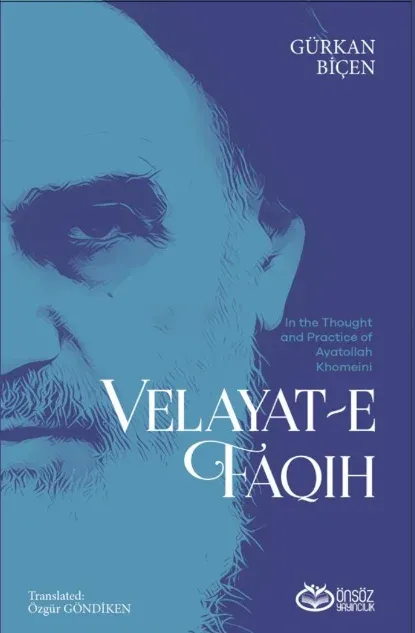
In the Thought and Practice of Ayatollah Khomeini VELAYAT-E FAQIH
What gives one person the right to rule over another who shares the same nature? This question, born of a lifelong search, lies at the heart of Gürkan Biçen's study of Velayat-e Faqih — the doctrine of the guardianship of the jurist that underpins the Islamic Republic of Iran.
Tracing the idea from its roots in classical Islamic and Twelver Shi'i thought through Ayatollah Khomeini's decisive reformulation, this book examines the conditions, powers, and legitimacy of the vali-ye faqih, and follows the doctrine from theory into the realities of governance. It closes with a critical survey of the juridical and political objections raised against it by scholars from Shariatmadari and Khu'i to Soroush, Kadivar, and al-Katib.
Grounded in years of doctoral research, Velayat-e Faqih offers readers a rigorous and balanced guide to one of the most consequential political-theological ideas of the modern Islamic world.
What gives one person the right to rule over another who shares the same nature? This question, born of a lifelong search, lies at the heart of Gürkan Biçen's study of Velayat-e Faqih — the doctrine of the guardianship of the jurist that underpins the Islamic Republic of Iran.
Tracing the idea from its roots in classical Islamic and Twelver Shi'i thought through Ayatollah Khomeini's decisive reformulation, this book examines the conditions, powers, and legitimacy of the vali-ye faqih, and follows the doctrine from theory into the realities of governance. It closes with a critical survey of the juridical and political objections raised against it by scholars from Shariatmadari and Khu'i to Soroush, Kadivar, and al-Katib.
Grounded in years of doctoral research, Velayat-e Faqih offers readers a rigorous and balanced guide to one of the most consequential political-theological ideas of the modern Islamic world.
| Taksit Sayısı | Taksit tutarı | Genel Toplam |
|---|---|---|
| Tek Çekim | 325,00 | 325,00 |
-
-
%35İNDİRİM350,00TL 227,50TL


-
%35İNDİRİM400,00TL 260,00TL
-
%35İNDİRİM270,00TL 175,50TL
-
-
-
-
-
-
%35İNDİRİM320,00TL 208,00TL
-
%35İNDİRİM350,00TL 227,50TL